
Does Renting Make You Rich?

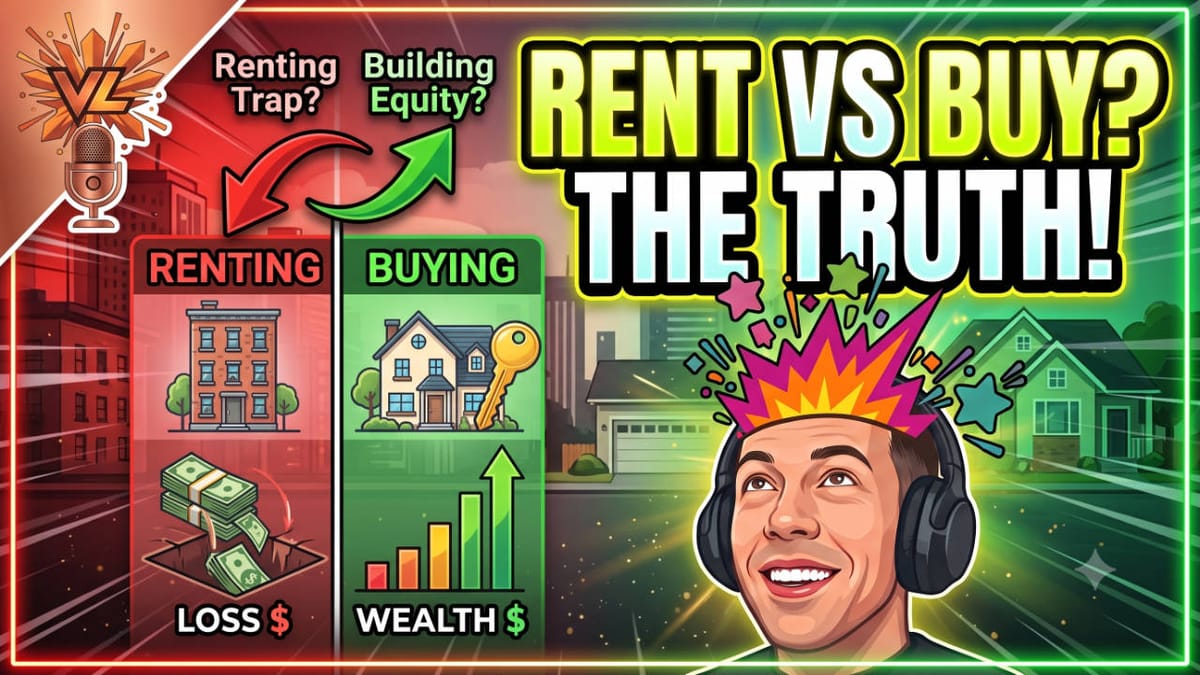
My coworker John is convinced that buying a house is a massive financial trap, and that renting is the ultimate cheat code to getting rich.
Arguing with John about economics is a lot like rolling on the mat with one of the 240-pound teenagers I coach in Jiu-Jitsu. He has absolutely unlimited energy, and I am just surviving and waiting for his battery to drain to make a move. (I just realized this metaphor is probably really hard to get if you’ve never heard of Brazilian Jiu-Jitsu or MMA. Too bad.)
Anyways, the crazy part is that mathematically, his spreadsheet logic is flawless. But his spreadsheet ignores one little thing called—real life.
The Starting Line
Let’s be honest. Nobody wakes up one day at the age of 25 and casually decides between buying a house and funding a massive stock portfolio. When you are just starting out, you aren't even thinking about buying a place. The only math you care about is making sure your paycheck covers rent, groceries, and your brand-spanking-new iPhone you get every year.
But eventually, you grind it out, quit your part-time jobs, and start a professional career. Just as you are starting to think you’ve made it, the universe finds a way of punishing you for making a little extra money.
The second you decide to start saving, life steps in. Your car suddenly needs a massive repair, or you convince yourself you desperately need to upgrade your PC to play Valorant, and continue to suck just as bad—only with amazing visuals. Don’t ask me how I know. Life is perfectly engineered to drain your bank account before the month is over, and until you become disciplined enough with your savings, you are already turning 30.
For those of you who inherited an obscene amount of money from a deceased monarch, you are already ahead of most, but I think you can still learn something from this. We’ve all seen what happens to lottery winners who never learned the discipline to save and invest.
But let’s say you lock in. You eat cheap, you hustle, and you bypass the inheritance starting line to build everything from scratch. After years of grinding, you are in your late 20s, and you finally scrape together just enough for a down payment. You are standing at the finish line of the hardest savings marathon of your life.
And that is the exact moment when someone like John, a co-worker who you actually like, taps you on the shoulder and says, "Wait... don't buy a house. Renting is actually better."
The Spreadsheet & The Game
This is where the "Rent vs. Buy" debate actually kicks in. John tells me that everyone is better off renting based on the "Rent and Reinvest" strategy.
When you buy a house, your hard-earned down payment gets locked away inside the bricks and drywall of the house. You can't touch it. It is what they call trapped equity. But if you rent, that cash stays in your pocket. If you take that massive down payment and throw it into an index fund, it will historically outperform your house appreciation and your wealth will explode.
Let's play a quick game. Take five seconds and try to guess what eats up most of a homeowner's cash after the down payment.
Time's up!
It's maintenance, closely followed by property taxes! So if your answer was one or the other, congratulations. You are smarter than the average bear. When you rent, you don't pay for a broken furnace, a flooded basement, or a damaged roof. John's spreadsheet takes all those avoided costs, adds them to the stock market pile, and creates a graph that goes straight to the moon.
The Twist
This is the moment when you think you have this figured out. But why are we only halfway through the article? Well, that’s because there is a catch. There’s always a catch.
It turns out that to benefit from John’s "Rent and Reinvest" strategy, you have to actually not only invest the down payment you saved, but also keep investing at the rate you were saving money for a down payment to begin with.
To do all that, we need motivation. The house you will eventually own is a pretty big and clear proverbial carrot on a stick, but I don’t think many of us can picture the future value of the money we invest. And since we don’t live inside spreadsheets and have our needs and wants, saving becomes infinitely more difficult.
We live in a world perfectly engineered to make you spend money. At the end of a long and exhausting work week, the last thing you want to do is transfer your hard-earned cash into a brokerage account—especially when the iPhone 18 Pro Max has your name on it! If you spend that money on lifestyle upgrades, the entire "Rent and Reinvest" strategy collapses instantly, and you are stuck with neither equity nor an investment.
The Micro-Rent Trap
Let’s shrink the concept of renting down to its most irritating micro-scale.
For longer than I care to admit, I was held captive by a water heater. I was paying a monthly toll just to keep the appliance in my basement, effectively subscribing to the concept of a warm shower. When I finally snapped and initiated a buyout to own the tank outright, handing over the lump sum felt exactly like paying a ransom.
But the sheer psychological thrill of cutting that monthly cord? Massive. Now, imagine taking that exact feeling of liberation and magnifying it to fit the four walls and the roof of the home you sleep in.
The Generational Reality
In your twenties, renting feels like the ultimate lifestyle subscription. You pay a flat monthly fee for unattached, consequence-free living, and if the fridge suddenly dies, it’s not your problem. But eventually, the math rudely shifts. You grow up a bit, and suddenly that "freedom" starts looking a lot like instability.
When I rented, it honestly felt like playing a highly competitive PC match on someone else's terrible server. You have zero control, the rules can change, and the lag is real.
My personal desire to own a place to call home was deeply engraved in me. There was no inheritance waiting for me. There was no family wealth saved up to provide a safety net. Everything I have achieved was built from scratch, and it made the purchase of a house so much more special.
For me, homeownership always represented something more than a savvy investment strategy. Owning a house gave me peace of mind, a patch of earth under my feet, and a roof over my head that belonged entirely to me and my family.
The Cheat Code
So, now that the question of renting or owning is as clear as mud, I think you're starting to understand that the answer truly is: it depends.
It depends on many things: how old you are, where you live, what your goals are, and what actually drives you.
Because this decision is so personal, I built a calculator you can use for free to help you figure it out. You can find the Rent vs. Buy Calculator and other articles just like this at virallogic.app.
I want to conclude by saying that John looks at a house and sees a physical asset. I look at a house and see a sanctuary and a place to call home. Which one are you? Let me know in the comments below, and go play with that calculator!
Watch on YouTube
Disclaimer: Tools and information provided are for illustration and entertainment purposes only and were produced with help of AI. We bare no responsibility for actions taken based on our content. Always consult with a certified professional before making financial decisions.